
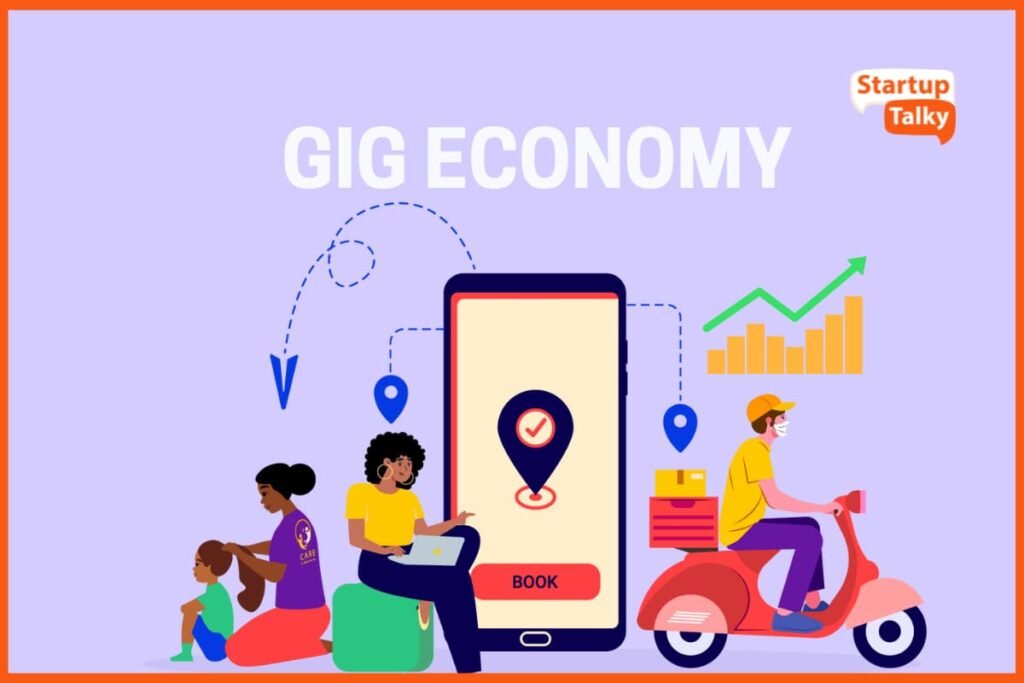
Introduction
The traditional job structure has undergone a significant transformation in modern times. While
people previously earned a living by working in a permanent job, the ‘Gig Economy’ has now
created new employment opportunities. Especially with the expansion of digital technologies,
freelancing, part-time jobs, and project-based work have completely transformed the way we
work. This blog will discuss in detail the growing popularity of the gig economy, its benefits,
challenges, and future prospects.
Part 1: Introduction to the Gig Economy
The gig economy is a system in which people earn income through small projects, temporary
work, freelancing,https://www.uber.com/
https://www.freelancer.com/ and part-time jobs, rather than full-time employment.
https://www.upwork.com
The term “gig” refers to small tasks or https://www.fiverr.com/ temporary work. In this model,
companies hire freelancers or contract workers on an as-needed basis instead of employing
permanent employees. Platforms like Uber, Freelancer.com, Upwork, Fiverr, and TaskRabbit are
prominent examples of the gig economy.https://en.wikipedia.org/wiki/Gig_economy
1.2 The Rise of the Gig Economy in India
The gig economy in India has grown rapidly over the past few
years.https://www.digitalindia.gov.in/ The Digital India campaign, affordable internet access,
and widespread mobile phone penetration have popularized freelancing and part-time work. Jobs
in content writing, web development, digital marketing, graphic designing, and online tutoring
have boomed in the country, particularly in areas like PayPal, Upwork, Freelancer, and other
platforms have connected Indian talent to the global market.https://www.skillindia.gov.in/
1.3 Global PerspectiveThe gig economy has become a major employment model worldwide. Developed countries like
the United States, the United Kingdom, Canada, and Germany employ millions of gig workers.
According to OECD data, approximately 30% of workers globally are engaged in this economy.
https://www.oecd.org/employment/gig-economy.htm The COVID-19 pandemic has accelerated
the growth of the gig economy, further accelerating the growth of the gig economy. Companies
have prioritized temporary contracts and project-based work models over full-time employment.
Part 2: Advantages of the Gig Economy
2.1 Flexibility and Freedom
The biggest advantage of the gig economy is flexibility. Freelancers or part-time workers can
choose their working hours and projects as per their convenience. This allows them to manage
their time. For example, a graphic designer can earn a good income even by working 4 hours a
day, allowing them to balance their education or other activities.
2.2 Variety and Expansion of Experience
Gig workers can broaden their skills by working on a variety of projects. They gain experience
with different industries, clients, and technologies that would not be possible through a
traditional job. For example, a freelance writer can expand their knowledge by writing content on
a variety of topics.
2.3 Access to Global Opportunities
Through the gig economy, Indian participants can work on projects for global companies. By
registering on platforms like Upwork and Freelancer.com, they can receive projects from
anywhere in the world. This reduces https://www.freelancer.com/ dependence on the domestic
market and allows them to earn income at international rates.https://www.upwork.com/
2.4 Low Initial Investment
Entering the gig economy doesn’t require a large investment. With a computer, an internet
connection, and the necessary skills, one can start working from home.https://www.edx.org/
Especially in the digital field, where office space, equipment, and other resources are not
required, freelancers and part-time workers can easily start working.https://www.udemy.com/
Part 3: Challenges of the Gig Economy
3.1 Unstable Income
The biggest challenge for gig workers is the instability of income. Compared to regular full-time
jobs, gig work offers less certainty in terms of project availability. Sometimes, there aren’t
enough projects available, leading to a decline in income. This forces freelancers to constantly
seek new clients.
3.2 Lack of Social Security
Gig workers don’t receive benefits like pension, graduation, or health insurance like traditional
jobs. Most freelancers and part-time workers have to plan their own futures. This lack of security
can make their financial situation unstable in the long run.https://www.freelancersunion.org/
3.3 Complexity of Taxes and Regulations
Clear and consistent regulations on the gig economy have not been developed in India. This
means that freelancers and part-time workers have to manage their own taxation, insurance, and
contract management. This can lead to incorrect tax filings, contract disputes, and other legal
issues. However, the government is making efforts to establish regulations for gig
workers.https://labour.gov.in/gig-workers
3.4 Work-Life Balance
While flexibility is a major advantage of the gig economy, maintaining a work-life balance can
be challenging. Freelancers have to work according to client deadlines, which can sometimes
lead to irregular working hours. This can also lead to mental stress and health
problems.https://labour.gov.in/gig-workers
Part 4: Skills Required for Success in the Gig Economy
4.1 Technical Skills
Working on digital platforms requires technical skills. Web development, app development,
design, and more.https://learndigital.withgoogle.com/digitalgarage
4.2 Communication Skills
Clear and effective communication with clients is essential. Gig workers need to understand and
clearly articulate project details, deadlines, revision requirements, and feedback.
4.3 Time Management
Gig work requires meeting different deadlines for different clients. Therefore, time management
and project prioritization are crucial. Tools like Trello, Asana, and Notion are helpful in this
regard.https://asana.com/
4.4 Marketing and Self-Branding Marketing oneself for projects has also become an essential skill. https://asana.com/ Gig workers
must create and upload their profiles to platforms such as Upwork, Fiverr, and Freelancer.com.
https://www.notion.so/ They should also showcase their expertise on social media platforms to
attract new clients.https://trello.com/
Part 5: The Indian Government and the Gig Economy
5.1 Policy and Regulations
The Indian government has taken several steps to develop regulations for gig workers. Recently,
the government launched a Minimum Security Network for gig workers to ensure their health,
pension, and other social security rights.https://labour.gov.in/
5.2 Digital India Initiatives
Increasing internet coverage, conducting digital literacy campaigns, and expanding digital
payment systems are among the government’s priorities under the Digital India plan. This has
provided opportunities for people in small towns and rural areas across the country to join the gig
economy.https://www.digitalindia.gov.in/
Part 6: Future Prospects
6.1 Impact of Artificial Intelligence
AI-based automation systems are working to make freelancers and part-time workers more
productive.https://cloud.google.com/products/ai For example, AI writing assistants for content
writers, AI design tools for graphic designers, and AI data processing tools for data analysts are
helping save time and improve
quality.https://emerj.com/ai-glossary-terms/what-is-artificial-intelligence/
https://www.canva.com/features/ai-image-generator/
6.2 New Business Models in the Gig Economy
New business models are emerging through freelancing agencies, work management platforms,
and skill training portals. These businesses aim to provide a more stable and secure environment
for gig workers. For example, companies like Toptal connect high-quality gig workers with
companies, allowing them to secure more stable and regular projects.https://www.toptal.com/
6.3 Education and Skill Development
Given the increasing competition in the gig economy, there will be a greater focus on skill
development in the future. Online courses, https://learndigital.withgoogle.com/digitalgarage
certification programs, and skill-based training can help gig workers strengthen their careers.
Initiatives like NASSCOM and Skill India are working in this direction.
https://www.udemy.com
https://www.edx.org/
6.4 Social and Economic ImpactThe gig economy has had a profound impact on the social and economic landscape. While
traditional jobs previously provided a stable work environment, the gig economy has completely
transformed the nature of employment. This has led to shifts in the mindset and working patterns
of various sections of society.
https://www.weforum.org/reports/the-future-of-jobs-report-2020
From a social impact perspective, the gig economy has provided employment opportunities for
women, the elderly, and students. Traditional jobs lacked women’s empowerment and workplace
flexibility, leaving many people without employment. However, freelancing and part-time work
models have allowed them to work from home, providing a powerful means for women to
become self-reliant.
https://www.unwomen.org/en/what-we-do/economic-empowerment/digital-inclusion
The gig economy has also provided new opportunities for the elderly. Senior citizens with
experience and expertise can offer their consulting services, writing, or consulting services. This
provides them with a source of income and allows them to remain active in society.
From an economic perspective, the gig economy has opened new doors for job creation.
Traditional employment models typically employed a fixed number of workers, typically
employed by large industries and organizations. However, the gig economy provides workers as
needed, reducing industry costs and creating a more flexible workflow.
Furthermore, the gig economy has encouraged micro-entrepreneurship. Small businesses,
startups, and individual entrepreneurs can leverage their own skills. The convenience of digital
marketplaces allows even small entrepreneurs to reach global customers. For example, a
freelance web designer can contract with an international client for their work, generating foreign
exchange.
6.5 The Role of Technological Infrastructure and Platforms
The expansion of the gig economy would not have been possible without the development of
technological infrastructure. Affordable internet access, cloud computing, and a multitude of
mobile applications and platforms have provided new opportunities for freelancers and part-time
workers.https://www.ibm.com/cloud/learn/cloud-computing
Major platforms like Upwork, Freelancer, Fiverr, TaskRabbit, Guru, and Toptal provide a
seamless interface between gig workers and clients. These platforms ensure the credibility of gig
workers through project posting, bidding systems, secure payment gateways, and review
systems.https://azure.microsoft.com/en-in/overview/what-is-cloud-computing/
Additionally, mobile applications like Google Pay, Paytm, and PhonePe have made financial
transactions easy and secure. While freelancers previously faced difficulties receiving payments,
fund transfers through online https://www.fiverr.com/ payment systems are now instant and
secure.https://www.guru.com/ Micro-work platforms like Amazon Mechanical Turk and Clickworker are useful for small tasks.
For example, data entry, content moderation, captioning, and basic research tasks are being
completed by gig workers https://www.taskrabbit.com/ around the world through these
platforms.
In addition, time management and project management tools like Trello, Asana, and
Monday.com have helped keep work organized and running smoothly. Gig workers can track
their responsibilities, set deadlines, and collaborate with their team.
6.6 Financial Management and Tax Issues
Financial management in the gig economy is more challenging than in traditional jobs. Because
gig workers’ incomes are unstable, they must manage their own income and expenses. This
makes budgeting, invoicing, tax filing, and retirement planning
crucial.https://www.incometaxindia.gov.in/Pages/tax-information-services.aspx
In India, income tax rules for gig workers are unclear, leading to tax-related uncertainties. For
example, a freelancer must account for income falling under different tax slabs for each project.
However, the government is soon taking initiatives to implement a clear tax policy for gig
workers.
In addition, freelancers and part-time workers must choose their own insurance and pension
plans. Organizations like the Pension Fund Regulatory and Development Authority (PFRDA)
and the National Insurance Regulatory and Development Authority (LIC) are offering pension
plans and insurance packages tailored to gig workers. New digital financial planning tools are
also being developed in this area, assisting gig workers with financial planning.
https://quickbooks.intuit.com/r/self-employed/freelancer-taxes-guide/
6.7 Mental Health and Work-Life Balance
Gig workers face particular challenges in maintaining work-life balance and mental health.
Constantly seeking new projects, unstable income, stressful deadlines, and sometimes excessive
workload can adversely impact mental health.https://www.headspace.com/
https://www.betterhelp.com/
To address these issues, the use of digital health platforms like BetterHelp, Talkspace, and
Headspace has increased. These platforms offer mental health counseling, meditation guides, and
stress management tools.https://www.talkspace.com/
Smartphone applications and web portals can help gig workers balance their work and personal
lives. Time management tools and online courses on work-life balance tips have become
available, providing users with the guidance they need to maintain mental health.
•Building a Social Security Network
Social security networks are being developed to ensure the safety of gig workers. The Indian
government recently announced the Gig Workers Social Security Scheme, which will provide
health insurance, accident insurance, and pension coverage. This scheme has been designed with
gig workers’ financial security in mind.https://labour.gov.in/gig-workers
In addition, many private companies are also offering insurance plans, salary advances, and
workshops for gig workers. For example, companies like Urban Company and Swiggy have
launched health insurance and professional development training programs for their freelance
service providers.https://www.ilo.org/global/topics/future-of-work/lang–en/index.htm
Future schemes like Universal Basic Income (UBI) are also being considered for gig workers,
providing them with guaranteed income during times of instability. Internationally, several
countries are also testing models that would ensure minimum financial security for gig
workers.https://www.swiggy.com/
Innovative Solutions: Beyond Traditional methods
Conclusion
The gig economy has revolutionized today’s employment landscape. It offers freedom, flexibility,
and opportunities to work without the constraints of traditional jobs. In India, the digital
revolution, affordable internet access, and smartphone penetration have given the gig economy
new dimensions, providing new employment options to millions of youth, women, and
experienced professionals. The impact of gig working is also rapidly growing globally, giving
rise to new business models, platforms, and technological
innovations.https://www.urbancompany.com/
The benefits are clear – flexibility, access to global opportunities, skill development, and low
initial investment. But the challenges are also significant – unstable income, lack of social
security, tax complexities, and mental health issues. Governments, private organizations, and
technology platforms are working together to address these issues. Social security schemes,
online skill development programs, health insurance, and pension plans are gradually becoming
available to gig workers.
In the future, technological innovations such as artificial intelligence, cloud computing, and
machine learning will further strengthen the gig economy. This will not only increase worker
productivity but also ensure their safety and work-life balance. The growth of the gig economy
encourages individual entrepreneurship and opens a new avenue for global economicempowerment.
https://www.oecd.org/social/universal-basic-income.htm
Ultimately, it’s fair to say that the gig economy is not just a temporary trend, but has become the
employment model of the future. Its impact is making the global work culture more flexible,
inclusive, and technologically advanced. We must understand its challenges and develop
solutions to ensure this system is sustainable and beneficial for all.