
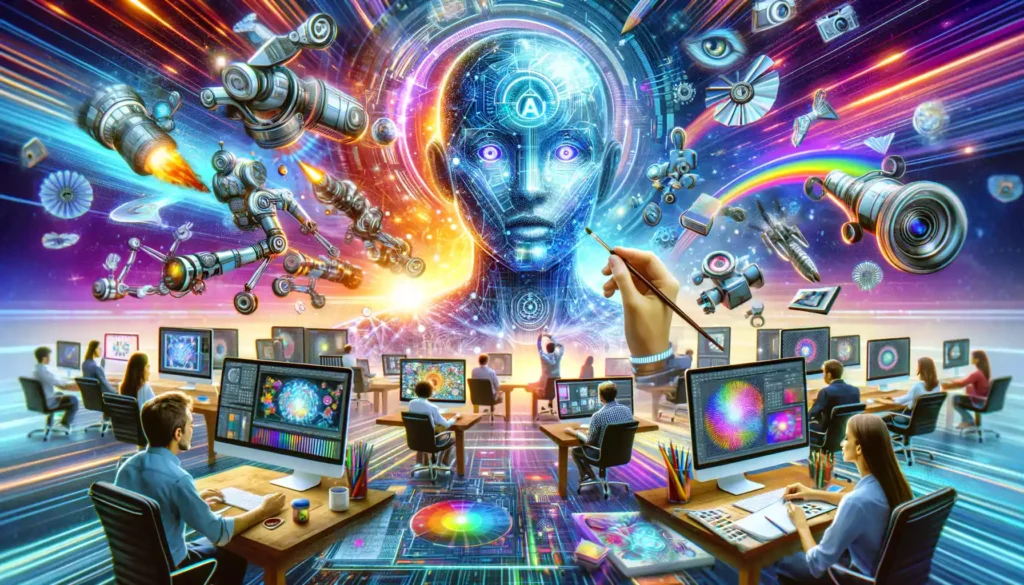
The Rise of AI-Generated Content: Impact on Creative Industries
In today’s digital age, technology has touched every aspect of our lives. From mobile phones, internet, social media, cloud computing to artificial intelligence (AI), technology has completely changed our daily routine. In this sequence, the rise of AI-generated content has also emerged as a big revolution. Earlier, where content creation was completely dependent on human skill, imagination and hard work, now AI based tools have made this process very simple, fast and economical. Today we will understand in detail what AI-generated content is, its advantages, challenges, current scenario, and its possible impact in the future.
AI-generated content: An introduction
AI-generated content means creating text, images, videos, audio, etc. with the help of artificial intelligence. For example, OpenAI’s ChatGPT is a tool that can communicate like a human, write blogs, prepare essays. Similarly, tools like MidJourney and DALL·E create custom images based on text prompts. This technology has evolved so much in the last few years that today no person needs in-depth technical knowledge to create complex designs, articles or videos. They just know how to write the right prompt.
Major tools for AI-generated content
1. ChatGPT – Useful tool for text generation, capable of writing essays, blogs, scripts and dialogues.
2. MidJourney & DALL·E – Tools for image generation from text, which are helpful in creating artwork and graphics.
3. Pictory.ai – Allows to convert text to video.
4. Synthesia.io – A platform for AI-generated video production, which uses AI voice and avatar.
Through these tools, tasks that were previously considered complex can be done in minutes today. This saves both time, effort and cost of the content creator.
Advantages of AI-generated content
1. Fast and efficient production
AI tools create content in seconds. For example, a businessperson can now create their blog posts in minutes, not hours. This has made the process of content creation much faster.
2. Creativity at a lower cost
Traditional methods required a lot of human labor to create articles, images, or videos. With the help of AI tools, quality content can be created without a large budget. This is proving to be especially useful for small businesses.
3. Multilingual content generation
In today’s global era, the need for content in different languages is increasing. AI tools can generate content in many languages, including Hindi, English, Spanish, French, making it easier to target a global audience.
4. Accurate targeting and personalization
AI tools not only generate content, but can also produce personalized content by understanding the user’s needs and trending topics. This is revolutionizing digital marketing and content marketing.
Ethical and business questions related to AI-generated content
1. Limitations of creativity
Although AI tools can generate content quickly, it does not have the depth, experience, emotional sensitivity and creative thinking of humans. AI cannot fully understand the depth of a poem or story.
2. Copyright and originality
AI generates content from data available on the Internet, which raises the question of copyright. Will the content generated by AI be considered original? If AI creates content by taking inspiration from another article or image, then who will have the copyright rights?
3. Impact on human employment
With the advent of AI, the jobs of content writers, graphic designers, video editors, etc. are under threat. Companies are now using AI tools instead of expensive humans, which may deprive many professionals of employment.
Social impact of AI-generated content
Content generation through AI has not only brought changes in the business world, but it has also had a profound impact on society. For example:
Changes in the education sector: Now students and teachers can easily prepare research, essays and project reports with the help of tools like ChatGPT. This has made the education process easier, but the problem of plagiarism and copy-paste has also increased.
Impact on media and journalism: Many news agencies are now using AI tools to prepare reports. This is making quick reporting possible in journalism, but at the same time questions are raised on the credibility of the news.
New era of creative expression: Artists are now creating new types of digital art, music and film projects with the help of AI tools. This is an extension of creativity, but will it be able to completely replace human expression? This question remains.
The future of AI-generated content
At present, we are only seeing the beginning. There will be many more technological advancements in the field of AI content creation in the future. According to experts:
1. Intelligent content curation
AI will not only generate content, but will also automatically suggest the best content by understanding the user’s interest, trends and behavior.
2. Hybrid creative workflow
Humans and AI will create content together. For example, a writer will create a great article by getting a draft from an AI tool and adding his artistic understanding to it.
3. Better customization and editing tools
AI editors and graphic design tools will become more accurate, easy and powerful, giving creators a lot of time to create content.
This will take less effort.
4. Data-Driven Content Marketing
AI marketing tools will give a new dimension to brand promotion by creating more effective and targeted content by analyzing consumer data.
Real Use of AI Content Creation: Examples and Case Studies
Example 1: Business Blog Writing
A digital marketing agency uses AI tools to create 10 blog posts a week for its clients. The agency only tells the topic and main points, the AI software prepares the article itself. Then the content writer reads it and makes the necessary corrections. In this way the writing process is completed easy, quick and at a low cost.
Example 2: Social Media Content Creation
A fashion brand creates new graphics for social media posts using AI-generated image generation tools. Just by giving a text prompt, a custom design is ready. This saves time for the design team and makes it possible to create new ideas faster.
Example 3: Educational Content
Teachers can generate quizzes, notes, presentation slides, and online quizzes for students with the help of AI tools. This is making the educational preparation and learning process technologically empowered.
Challenges that need to be solved
1. Ethics and responsibility
Ethics plays an important role in AI content generation. Who will be responsible for every content – machine or human? For example, if AI generates incorrect information, who will be responsible for it?
2. Quality control
AI generated content is not always correct or of good quality. Therefore, review and editing of every content by human editors will be necessary to maintain accuracy.
3. Job and skill development
Professionals who do not improve their expertise to compete with AI may face an employment crisis. Therefore, learning new skills, learning to work together with AI will be important.
Inclusion of AI in training courses
The Department of Jobs and Skills has developed several special courses keeping this change in mind. These courses not only teach traditional skills, but also provide proficiency in using AI based tools. For example:
1. AI based content writing course – In this, trainees learn how to create high quality articles, blogs, advertising material with the help of AI tools. Also, special attention is also given to ensuring the originality of the content and ethical content creation.
2. AI-enabled graphic designing training – Trainees are given practical training on tools like Adobe Firefly, MidJourney, so that they can make their graphic design work faster and more effectively with AI.
3. AI-based video editing – The training teaches how to quickly edit video content, add effects, audio synchronization using AI tools.
4. Digital marketing and AI analytics – Trainees learn how to analyze market trends through AI tools, track content performance, and create better strategies.
Empowering entrepreneurship
With the help of AI-generated content, self-employment opportunities are also increasing. Many entrepreneurship development programs are being conducted under the Department of Jobs and Skills, in which youth are taught how to set up their business digitally through AI tools.
For example:
An independent content creator can now create social media content, website articles, product descriptions, etc. with the help of AI tools without a large team.
A graphic designer can create professional designs with AI-based tools without expensive software.
Freelancers can use AI to create faster and more effective content to start their business on the marketplace.
In this direction, the government also provides financial assistance schemes to promote self-employment. Under this, loans are provided to new startups, and guidance is provided by experts in business plan creation.
Women empowerment and the AI era
Providing self-employment opportunities to women by connecting them with technical education is also a priority of the Department of Jobs and Skills. Many women empowerment schemes have been designed in accordance with the AI era.
Women are being trained to become AI-based content creation, digital marketing, graphic designing, and virtual assistants. With this, women can step into the digital world independently and strengthen their financial position.
Rural women are also now becoming self-employed by joining digital platforms and selling their products online. With the help of AI tools, they are gaining expertise in marketing their business, digital presence management, and content creation.
Placement Services and Industry Collaboration
The Department of Jobs and Skills ensures that trained youth get jobs in the industry. Under this, placement fairs, career counseling sessions, and industry-institute interface programs are organized. This helps trainees get jobs.
Training courses are prepared in collaboration with the industry, so that trainees can be prepared and employed as per the demand of the industry. For example, IT companies develop special coding courses according to their requirements, and trainees get jobs after acquiring skills there.
Integration of Digital India and AI Skill Training
Under the Digital India Mission, the Department of Jobs and Skills has also included AI skill training. AI-based courses are being made available in digital literacy centers across the country. Under this, trainees learn:
Fundamentals of Artificial Intelligence
Introduction to Machine Learning Algorithms
About AI Tools
Content creation using
Using AI to make data analytics and business decisions
This type of training provides youth with future digital employment opportunities.
Future prospects
AI technology is likely to become even more influential in the coming years. The main goal of the Department of Employment and Skills is to ensure that every youth is trained with AI-based tools so that they can succeed in global competition.
The need for trained workforce, especially in the following areas, will increase rapidly in the future:
1. AI-enabled content creator
2. Digital marketing specialist
3. Data analyst
4. Cloud infrastructure manager
5. Cyber security specialist
6. Machine learning engineer
The government will continue to develop new courses from time to time, which are in line with the changing trends of the industry. Also, trainees will be provided professional certificates related to these courses.
Conclusion: It is important to maintain balance
AI-generated content is a new revolution that has completely changed the traditional model of content creation. It has brought efficiency, speed and cheaper processes in the field of business, education, media and art. But along with this, we have to use it in a balanced way by understanding its limited aspects, ethical questions and impact on employment.
In the future, humans and AI together will create such a creative world where the features of both will complement each other. This will be the right direction. We have to take our society and industry forward by using AI with complete caution and prudence.
Role of the Department of Employment and Skills in Empowering the Creative Industry in the AI Era
As Artificial Intelligence (AI) technology is rapidly developing, the scope of its impact is also widening. The contribution of AI is clearly visible especially in creative industries such as writing, graphic designing, video production, digital marketing, advertising creation, etc. At such a time, the Ministry of Employment and Skills of the Government of India (Ministry of Skill Development and Entrepreneurship – MSDE) is playing an
important role in ensuring that the youth of the country are equipped with adequate and effective skills in line with the AI era.
The challenge of the Department of Employment and Skills in front of AI-generated content
Due to AI, there are rapid changes in the creative industry. While earlier creative work was done in a traditional way, today AI tools can prepare articles, images, videos, etc. in minutes. Its impact is not only in increasing productivity, but also on the employment structure. In such a situation, the challenge before the Department of Employment and Skills is to equip the youth with skills in accordance with this changing scenario.
Many traditional creative jobs such as content writers, graphic designers, video editors, social media managers, etc. are being directly impacted by AI tools. For example, tools such as ChatGPT, Jasper, MidJourney, DALL·E are rapidly creating content. At such a time, the aim of the Department of Jobs and Skills is to provide the youth with technical proficiency as well as depth of creativity.